When the System Fails You: Why I Built Tickie
Angela – Founder of Tickie
8 min read


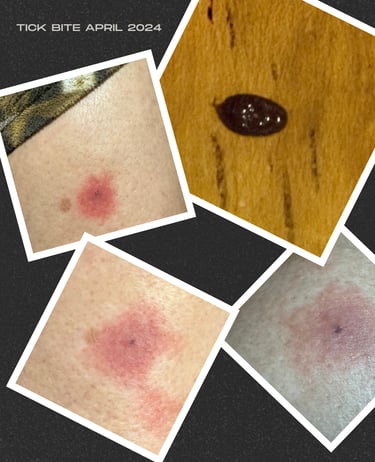
The moment I found that engorged tick on my shin in April 2024, I knew exactly what was coming. Not the disease itself, but the dismissal. The disbelief. The loneliness of being told your suffering isn't real.
I'd been through this before with my traumatic brain injury years earlier. Told it was "just anxiety." That I was depressed. That it was all in my head. So when I walked into Patient First with a photograph of the tick and a textbook bullseye rash forming within 24 hours, I shouldn't have been surprised when the doctor refused to even look at the picture. "I don't like ticks," she said.
Neither do I. But I thought it might be medically relevant.
She did prescribe doxycycline, three weeks' worth. But when I called back because the medication was causing problems and asked for an alternative, everything changed. Suddenly, she announced that I didn't have Lyme disease at all. I had "something else." No explanation. Just a dismissal that felt achingly familiar.
I took the doxycycline anyway. All of it. Even though it made me feel terrible, I pushed through because what choice did I have?
A Trail of Negative Tests
A few months later, I had bloodwork done through Quest. Negative. All of it. Negative.
Here's what they don't tell you: current Lyme disease tests only detect antibodies your body makes in response to the bacteria, not the bacteria itself. Studies show up to 50% of tests result in false negatives during early disease, and serologic assays may be falsely negative during the first 4-6 weeks after infection. The tests we're using haven't fundamentally changed in about 30 years.
I learned that according to the CDC, a doctor should make a Lyme diagnosis based on symptoms, medical history, tick exposure, and geographic area. Blood tests should only support that diagnosis, not be used alone to determine if you do or don't have Lyme. But that's not what happens in practice. In practice, a negative test means you're told you're fine, even when you're clearly not.
The migrating joint pain started. The brain fog intensified, though I'd been dealing with that since my TBI, this felt different, heavier. Odd symptoms I'd never experienced before. But without positive test, I was on my own.
Forging My Own Path
I did what I've learned to do when the medical system fails me: I became my own researcher.
I watched YouTube videos from doctors treating Lyme. I watched documentaries featuring patients who'd found ways to
manage their symptoms. I pieced together a protocol from supplements that doctors online said were helping their patients.
Between working with AI tools and studying everything I could find, I developed a regimen that actually worked. Methylene blue and phenylpiracetam for brain health (which I was already taking for the TBI), combined with Lyme-specific supplements. Breathwork. Exercise, even when it was the last thing I wanted to do.
And for a while, I felt good. Really good.
The Fragility of Feeling Good
Then life happened. Stress from trying to re-enter the workforce after eight years. Difficult situations with colleagues. Software purchases that required refunds and months of struggle. I was so focused on surviving each day that I didn't notice when I ran out of supplements. I didn't replace them. I just... forgot.
Before I realized what was happening, I was in a full-blown flare-up.
This is the cruelest part of living with Lyme: even when you understand intellectually what's happening, even when you know it's the disease and the inflammation talking, it doesn't lessen how real it feels in the moment. The sense of hopelessness is overwhelming. The frustration with myself for getting off track. The fear of the unknown, because this isn't "widely acknowledged" by most healthcare providers.
Recent research from Northwestern University, published in 2025, finally validated what patients like me have been experiencing:
Post-Treatment Lyme Disease affects 14% of patients who were diagnosed and treated early with antibiotics, causing severe fatigue, cognitive challenges, body pain, and arthritis.
Scientists now believe this happens because the body responds to remnants of the Borrelia burgdorferi cell wall that break down during treatment but linger in the liver.
They're also discovering why this happens: Lyme's peptidoglycan is structurally unique, it sucks up sugars from the tick that carries it, creating a modification that prevents the liver from processing it properly. This persistence, combined with individual immune responses, impacts clinical outcomes. Some patients have stronger immune responses that could result in worse disease, while others' immune systems may largely ignore the molecule.
Reading this research felt like vindication. It's not in my head. It's in my liver. It's in my joints. It's real.
Building the Tool We Deserve
One morning, while waiting for my husband to text that he'd arrived safely at work (it's very early, and this has become
our routine), I was watching videos as I always do. That's where I learn about everything, AI, ketogenic diets, carnivore protocols, all of it. And that morning, I came across a video about the founder of rootd, an app for anxiety attacks.
She told a story that could have been mine, just with a different diagnosis. A college student having panic attacks, dismissed by healthcare providers, told it was nothing serious. So she built an app to help herself, and ended up helping thousands of others experiencing the same dismissal, the same lonely terror of not being believed.
I thought: I need this. Not just for anxiety. I have that too, from the trauma of being repeatedly dismissed, but for Lyme. For tracking symptoms that migrate and shift. For documenting medical interactions that gaslight and dismiss. For preparing for doctor visits so I don't forget crucial details when brain fog hits. For breathing exercises when the hopelessness feels crushing. For connection with others who understand.
I'm building Tickie because I'm actively living through a flare-up right now. Because I've spent too much money on virtual functional medicine doctors who couldn't help. Because the traditional insurance route has failed me completely, just like it failed me with my TBI. Because I'm watching brilliant people like Dave Asprey and others who've had to marshal enormous resources to heal themselves, and I'm acutely aware that most of us don't have those resources.
But we deserve help anyway.
The Science Is Finally Catching Up
While I'm building this app, the scientific community is finally starting to validate what patients have been saying for decades:
In March 2025, researchers at Virginia Commonwealth University discovered that an enzyme specific to Borrelia burgdorferi could serve as an ideal target for developing new therapeutics against Lyme disease.
Northwestern scientists identified an antibiotic called piperacillin that cured Lyme disease in mice at a dose 100 times lower than doxycycline, potentially offering hope for those who can't tolerate current treatments or for whom doxycycline doesn't work, which is up to 20% of patients.
Vaccine researchers at Tufts University made a breakthrough in April 2025 with a modified protein called CspZ that could offer long-standing protection against infection while requiring fewer vaccinations, addressing the decades-long gap since the last human Lyme vaccine.
And the scope of the problem is expanding: an estimated 476,000 people in the United States are diagnosed and treated for Lyme disease each year, with the range of blacklegged ticks more than doubling since 1990 and cases more than tripling over 20 years. Climate change is driving tick populations into areas where they've never been found before.
You're Not Alone
If you're reading this and you've been dismissed by doctors, if your tests came back negative but you know something is wrong, if you found a tick and developed symptoms but nobody will take you seriously, I see you. Your experience is valid.
In May 2025, Johns Hopkins researchers published findings confirming that Lyme disease is NOT a psychosomatic illness. It's not anxiety. It's not depression (though dealing with this disease can certainly cause both). It's real, it's physical, and you deserve proper care.
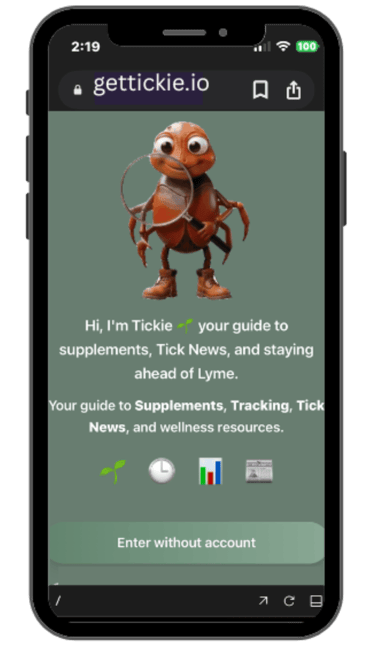
I'm building Tickie for us: the ones who've been told our symptoms aren't real, who've had to become our own doctors, who've spent hours researching and piecing together protocols because the system has abandoned us. It's going to be a tool to track symptoms, prepare for medical visits, practice calming techniques during flare-ups, and connect with others who understand this lonely, exhausting journey.
Because nobody should have to fight for basic medical care. Nobody should be dismissed when they're suffering. And nobody should have to navigate this alone.
I'm still in the thick of my own flare-up as I write this. Brain fog makes it hard to find the right words sometimes. But I'm doing the breathwork. I'm exercising even when it feels impossible. I'm taking my supplements again. I'm working to rebuild my protocol and my health so I can afford the kind of medical care that actually helps, the doctors who can't accept insurance because they're doing the work mainstream medicine won't.
Until then, we have each other. And soon, we'll have Tickie.
Stay tuned for updates on the app's development. If you'd like to be notified when Tickie launches or have features you'd like to see, please reach out. This is being built by someone who needs it just as much as you do.
About the author: I'm living with both a traumatic brain injury and Lyme disease, both of which were dismissed by traditional medicine for far too long. I'm building Tickie because I need it myself and because too many of us are suffering in silence, told our very real symptoms are all in our heads. We deserve better.
For the Post-Treatment Lyme Disease research:
Northwestern University (2025). "Post-Treatment Lyme Disease Syndrome May Be Driven by Remnants of Infection." Science Translational Medicine. https://news.feinberg.northwestern.edu/2025/05/12/post-treatment-lyme-disease-syndrome-may-be-driven-by-remnants-of-infection/
For the new antibiotic (piperacillin):
Northwestern University (2025). "Taking the bite out of Lyme disease." Science Translational Medicine. https://news.northwestern.edu/stories/2025/04/taking-the-bite-out-of-lyme-disease
For the vaccine breakthrough:
Tufts University (April 2025). "Alternative Approach to Lyme Disease Vaccine Development Shows Promise in Pre-clinical Models." Nature Communications. https://now.tufts.edu/2025/04/07/alternative-approach-lyme-disease-vaccine-development-shows-promise-pre-clinical-models
For the enzyme target discovery:
Virginia Commonwealth University (March 2025). "Researchers Discover Achilles Heel of Lyme Disease Pathogen." mBio. https://asm.org/press-releases/2025/march/researchers-discover-achilles-heel-of-lyme-disease
For testing accuracy information:
CDC. "Clinical Testing and Diagnosis for Lyme Disease." https://www.cdc.gov/lyme/hcp/diagnosis-testing/
Global Lyme Alliance. "When You Suspect You Have Lyme, But Your Test Comes Back Negative." https://www.globallymealliance.org/blog/when-you-suspect-you-have-lyme-but-your-test-comes-back-negative
For Johns Hopkins research:
Johns Hopkins Lyme Disease Research Center (May 2025). "Research Substantiates Lyme Disease is NOT A PSYCHOSOMATIC ILLNESS." https://www.hopkinslyme.org/news-impact/in-the-news/
For statistics:
CDC Lyme Disease Surveillance Data:https://www.cdc.gov/lyme/data-research/facts-stats/surveillance-data-1.html